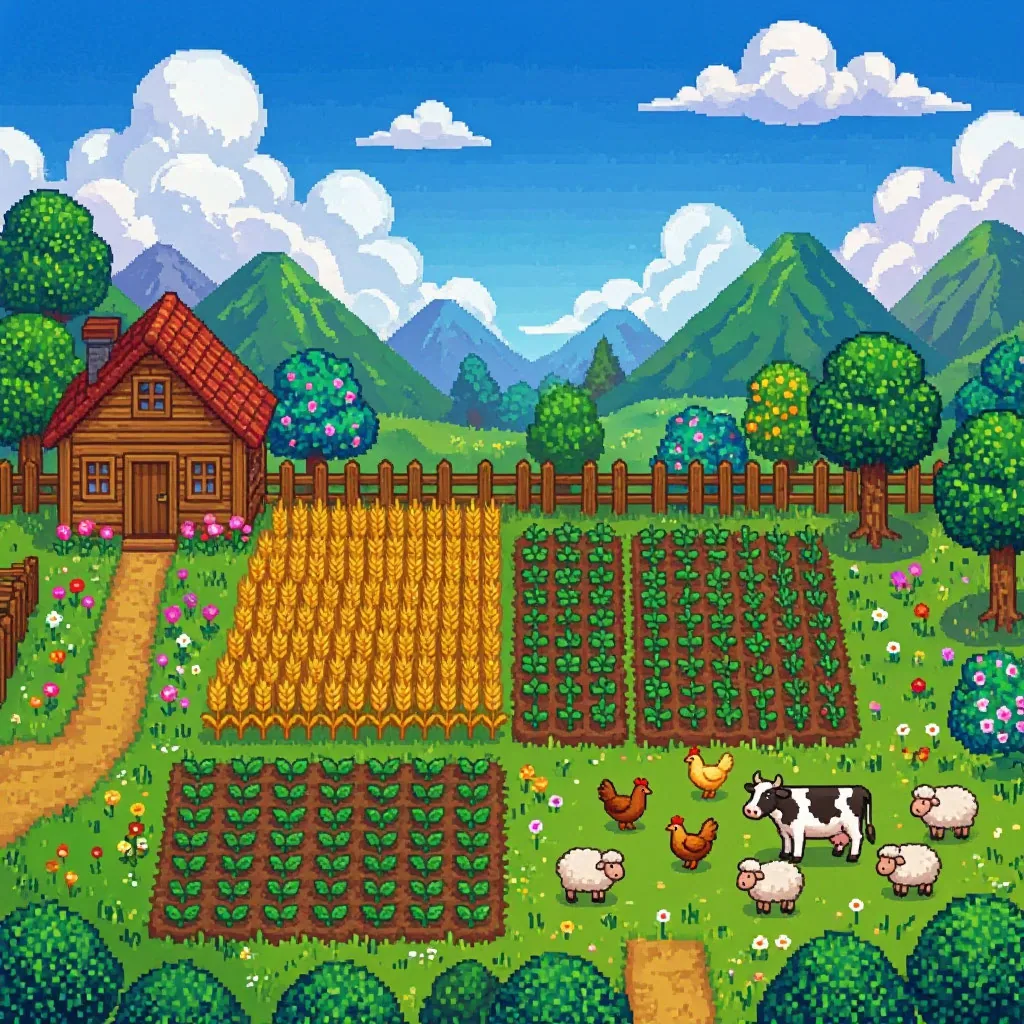

Master the agricultural mechanics of Stardew Valley with this comprehensive farming guide. Learn to optimize crop layouts with sprinklers, maximize profits through artisan goods like kegs and preserves jars, and build a highly efficient animal husbandry operation for year-round passive income.
Contents
Full Description
Core Agricultural Mechanics
Farming in Stardew Valley extends far beyond planting seeds. Early game relies on manual watering, but the primary goal is to automate this process. Clearing land and upgrading your Watering Can to Copper or Steel is the immediate priority. This reduces energy expenditure, leaving more stamina for mining or foraging.
The Sprinkler Evolution
Transitioning to automated watering is the most critical milestone for farm expansion. - Basic Sprinkler: Covers a 3x3 area. Unlocked at Farming Level 2. - Quality Sprinkler: Covers a 5x5 area. Unlocked at Farming Level 9. - Iridium Sprinkler: Covers a 7x7 area. Requires an Iridium Bar and a Gold Bar.
Arranging Iridium Sprinklers in a grid pattern with one empty tile between them ensures complete coverage without overlapping waste. This layout forms the foundation of any high-yield farm.
Animal Husbandry Strategies
While crops provide seasonal bursts of income, animals generate consistent daily revenue. - Chickens: The most accessible entry point. Upgrading the coop unlocks Blue Chickens and incubators, ensuring a steady supply of eggs for Mayonnaise Machines. - Cows and Goats: Require a Barn. Goats produce milk every other day, but Large Goat Milk yields high-value cheese. Cows offer daily Large Milk, making them highly reliable. - Pigs: The ultimate late-game livestock. When let outside on non-winter, non-rainy days, they dig up Truffles. With the Botanist profession, every truffle is automatically Iridium quality, generating massive profits.
Artisan Equipment: The Real Profit Drivers
Selling raw crops is inefficient. Processing them multiplies their value significantly.
| Equipment | Best Input | Profit Multiplier | Ideal Use Case |
|---|---|---|---|
| Keg | High-value fruit (Starfruit, Ancient Fruit) | 3x base value | Late-game passive income |
| Preserves Jar | Low-value vegetables (Green Bean, Corn) | 2x base value + 50g | Early to mid-game stability |
| Cheese Press | Large Milk or Large Goat Milk | High fixed value | Daily barn output processing |
| Mayonnaise Machine | Duck Egg or Dinosaur Egg | High fixed value | Coop automation |
Profession Selection
Your level 5 and level 10 farming choices dictate your economic strategy. The Tiller path is universally recommended. At level 10, choosing Artisan over Agriculturist is the definitive meta. Artisan goods sell for 40 percent more, which applies to Keg outputs, Cheese, and Truffle Oil, vastly outperforming the minor growth speed boost from Agriculturist


Comments 0
No comments yet — be the first.
Log in or sign up to leave a comment.