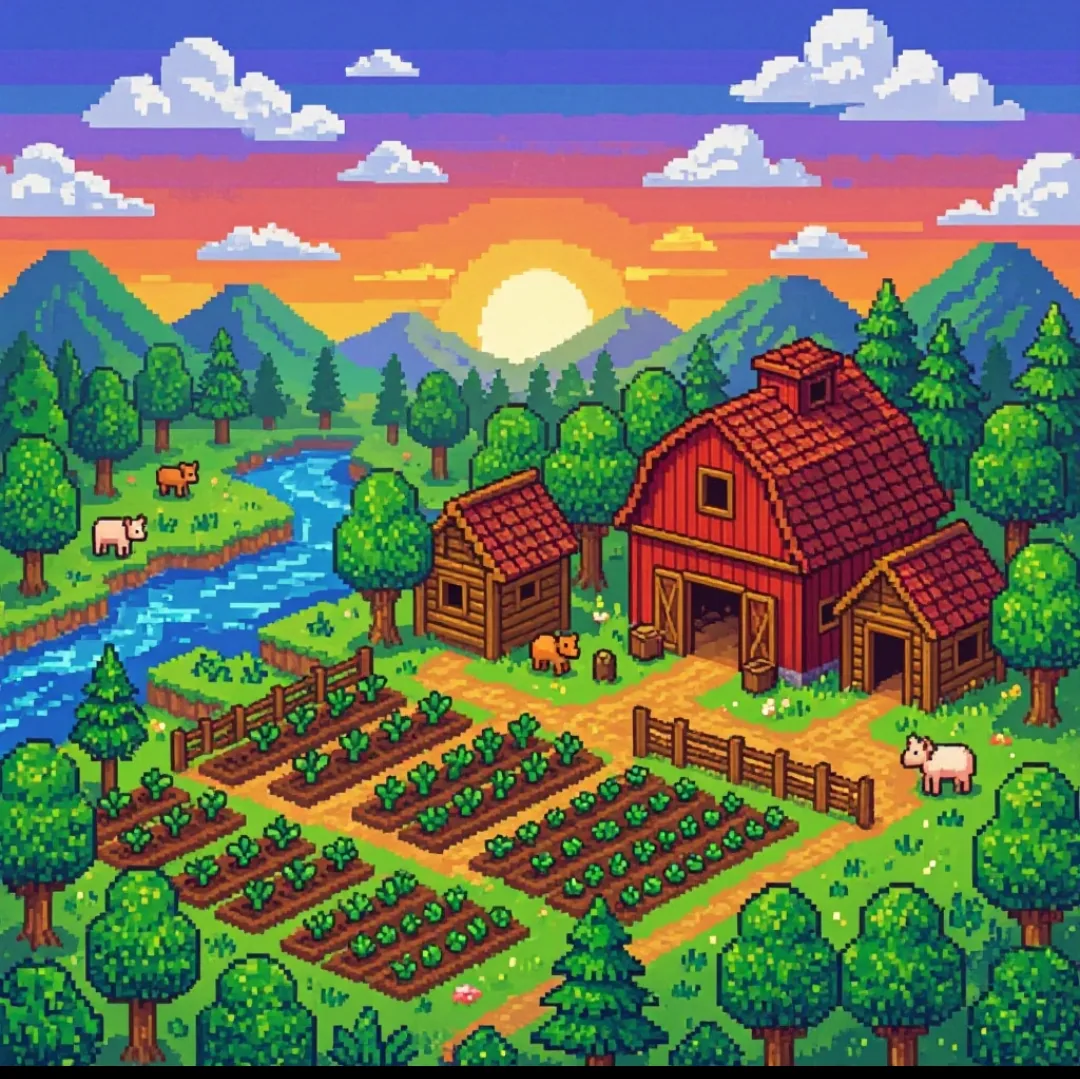

Starting your first farm in Stardew Valley? This beginner's guide covers the essential steps of your first spring: planting crops, gathering resources, managing energy, earning gold through fishing and upgrading tools. Learn how to prepare for the Community Center and avoid common early-game mistakes.
Contents
Stardew Valley Beginner's Guide: How to Start Your First Farm
Welcome to Pelican Town! You've inherited an old farm, a handful of tools and a chance to build a completely new life.
Your first spring is an opportunity to learn the basics of farming, exploration and earning money. However, with so many activities available, it can be difficult to decide what deserves your attention.
This guide explains how to spend your first days efficiently, where to find early income and which resources are worth keeping.
Your First Three Days
At the beginning, focus on establishing a small farm rather than clearing the entire property.
Day 1 - Plant Your First Crops
On most farm layouts, Mayor Lewis leaves you 15 Parsnip Seeds.
The exception is the Meadowlands Farm, where you start with chickens and receive hay instead.
Your first tasks are simple:
- Clear enough space near your farmhouse for a small field.
- Use your hoe to prepare 15 soil tiles.
- Plant the seeds and water them.
- Collect nearby wood, stone and fiber.
- Explore Pelican Town if you still have energy.
Parsnips require four days of growth. Seeds planted on Spring 1 and watered every day will be ready on Spring 5.
Avoid clearing every tree and rock immediately. Removing obstacles consumes valuable energy, and you only need a small cultivated area at first.
Day 2 - Explore and Start Fishing
Check your mailbox.
Willy, the local fisherman, invites you to visit him at the beach. During your first meeting, he gives you a free Bamboo Pole.
You can now earn money without waiting for crops to grow.
Spend some time learning the fishing minigame and explore the beach for forageable items.
Day 3 - Establish a Routine
Continue watering your field and gathering useful resources.
Good early priorities include:
- Practicing fishing.
- Collecting spring forageables.
- Meeting villagers.
- Saving wood for your first chest.
- Planning space for additional crops.
You don't need to accomplish everything immediately. Consistent progress is more valuable than exhausting your character every morning.
Managing Energy and Time
Energy is one of the most important resources during the early game.
Chopping wood, mining rocks, watering crops and fishing all consume it.
When your energy gets low, consider switching to activities that don't require tools, such as exploring town or talking to residents.
How to Restore Energy
Some wild plants can be eaten.
| Item | Use |
|---|---|
| Leek | Restores energy and health |
| Dandelion | Provides a small energy boost |
| Wild Horseradish | Useful as emergency food |
| Spring Onion | An accessible early food source |
| Daffodil | Useful for gifts and bundles, but restores no energy |
Keep a little food available before spending a full day fishing or clearing land.
When Should You Sleep?
A new day begins at 6:00 AM, and your character automatically passes out at 2:00 AM.
Passing out outside can result in a financial penalty.
Going to bed after midnight also reduces the amount of energy restored overnight.
For the best recovery, aim to sleep by midnight, provided your character is not exhausted.
Fishing - An Early Source of Gold
Fishing is a useful way to earn money while waiting for your first harvest.
You can catch fish in rivers, the mountain lake and the ocean. Different species appear depending on the season, weather and time of day.
How to Catch Fish
During the minigame, keep the fish icon inside the green bar.
Press or hold the action button to raise the bar, and release it to let the bar fall.
Small, controlled movements are usually easier than holding the button continuously.
If the mechanic feels difficult, Willy sells a Training Rod for 25g, which makes catching common fish easier.
When to Upgrade Your Fishing Rod
After reaching Fishing Level 2, you can purchase the Fiberglass Rod for 1,800g.
Unlike the Bamboo Pole, it supports bait.
You don't need to buy it immediately. Continue using your free rod until the additional investment makes sense.
Keep an eye on fish needed for Community Center bundles before selling your entire catch.
Upgrading Your Tools
Clint, the town blacksmith, can improve your equipment in exchange for money and metal bars.
Each upgrade takes two days to complete.
Choosing the right tool depends on how you prefer to play.
| Tool | Why Upgrade It? |
|---|---|
| Watering Can | Waters multiple tiles with charged actions |
| Pickaxe | Breaks rocks more efficiently, especially in the Mines |
| Hoe | Prepares larger patches of soil more quickly |
For a crop-focused farm, an upgraded watering can is particularly useful.
If you prefer mining, upgrading the pickaxe may be a better first investment.
The Best Time to Upgrade Your Watering Can
Check the weather forecast on your television.
When rain is predicted for the following day:
- Water your crops as usual.
- Take the watering can to Clint before his shop closes.
- Let the rain water your crops the next day.
- Collect the upgraded tool the day after that.
This avoids missing a day of watering, provided the blacksmith is open when you need to collect it.
Preparing for the Community Center
The Community Center is one of the game's major progression paths.
Its opening event can trigger from Spring 5 onward, under the appropriate time and weather conditions.
Before that happens, start collecting useful items.
Pay particular attention to:
- Spring forageables.
- Different seasonal crops.
- Fish from rivers, lakes and the ocean.
- Resources obtained through mining.
The Mines become accessible on Spring 5, giving you another important source of materials.
Once the bundle system is unlocked, check its requirements regularly before selling valuable or seasonal items.
You don't need to complete everything during your first spring. The important part is recognizing which resources may be difficult to obtain again until another season.
A Simple First-Week Checklist
- Plant and water your starting crops.
- Craft a chest for extra storage.
- Collect spring forageables.
- Meet Willy and receive your fishing rod.
- Earn your first gold from fishing.
- Harvest your initial parsnips.
- Visit the Mines when they open.
- Begin preparing resources for Community Center bundles.
Your first year doesn't have to be perfect. Start with a manageable field, explore at your own pace and reinvest your early profits into improvements that make everyday farming easier.


Comments 5
а вот и первый постик от местной легенды
Научитесь пожалуйста пользоваться промтом
а что не так? он по промпту делал
Это я уже всё сделал
Иначе я не буду ничего принимать больше
Log in or sign up to leave a comment.